projects
advanced computer vision, signal processing, and deep learning solutions across academic research and industry applications
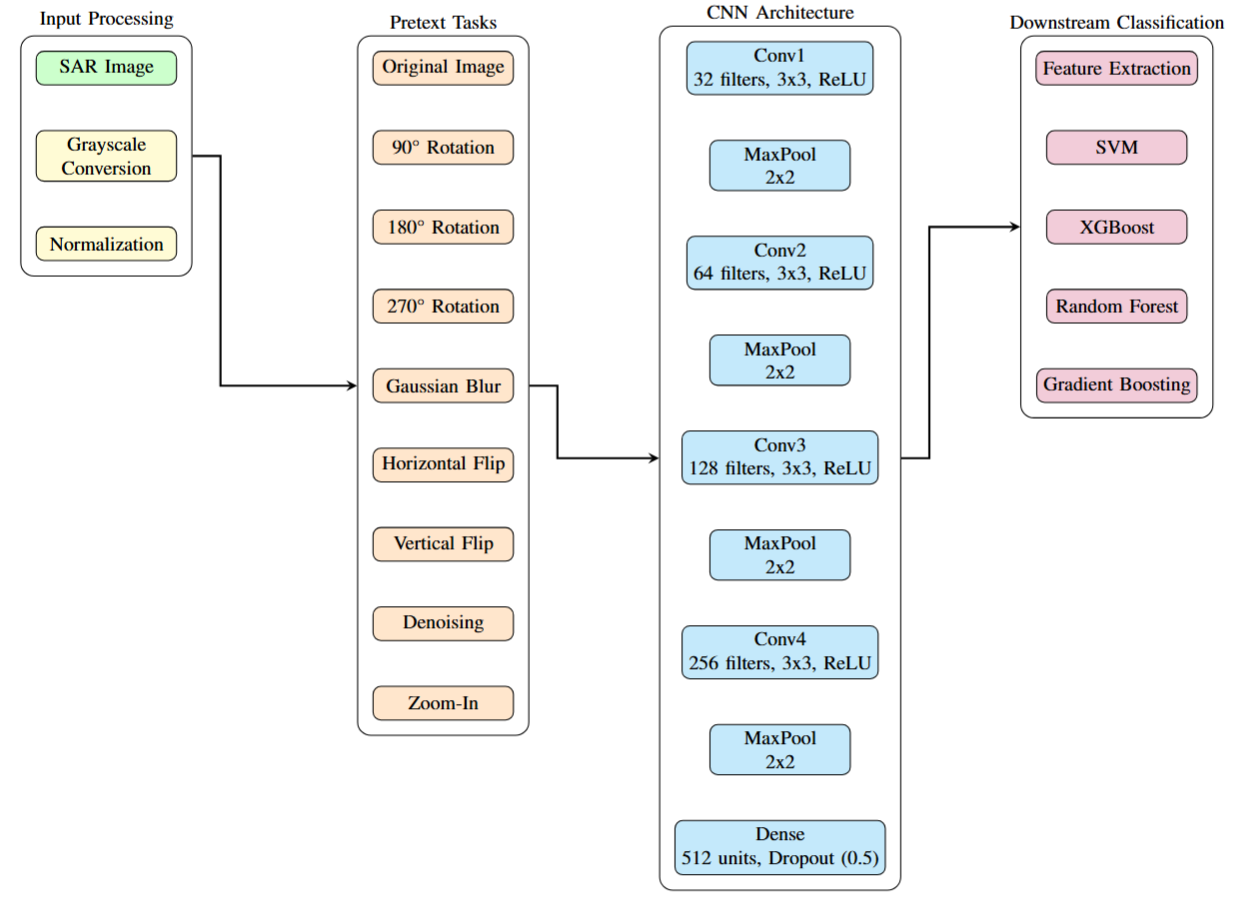
Advancing SAR Target Recognition Through Hierarchical Self-Supervised Learning with Multi-Task Pretext Training
Synthetic Aperture Radar (SAR) Automatic Target Recognition (ATR) systems face significant challenges due to limited labeled data availability and persistent domain gaps between synthetic and measured imagery. This paper presents a comprehensive self-supervised learning (SSL) framework that eliminates dependency on synthetic data while achieving state-of-the-art performance through multi-task pretext training and extensive downstream classifier evaluation. We systematically evaluate our SSL framework across diverse downstream classifiers spanning different computational paradigms and architectural families. Results demonstrate that SSL significantly improves SAR ATR performance, with SVM achieving 99.63% accuracy, ResNet18 reaching 97.40% accuracy, and Random Forest demonstrating 99.26% accuracy.
Self-Supervised Learning for SAR Target Recognition with Multi-Task Pretext Training
We developed a self-supervised learning framework for Synthetic Aperture Radar (SAR) Automatic Target Recognition that eliminates dependency on synthetic data while achieving superior performance. Our framework utilizes multi-task pretext training with nine complementary transformation tasks to develop robust feature representations from measured SAR data. The experimental findings demonstrate competitive performance with 89.78% accuracy using SVM classifier and robust detection capabilities even with limited training data, outperforming traditional methods that rely on synthetic data augmentation. This work establishes a foundation for leveraging self-supervised learning in domain-specific applications with limited labeled data.
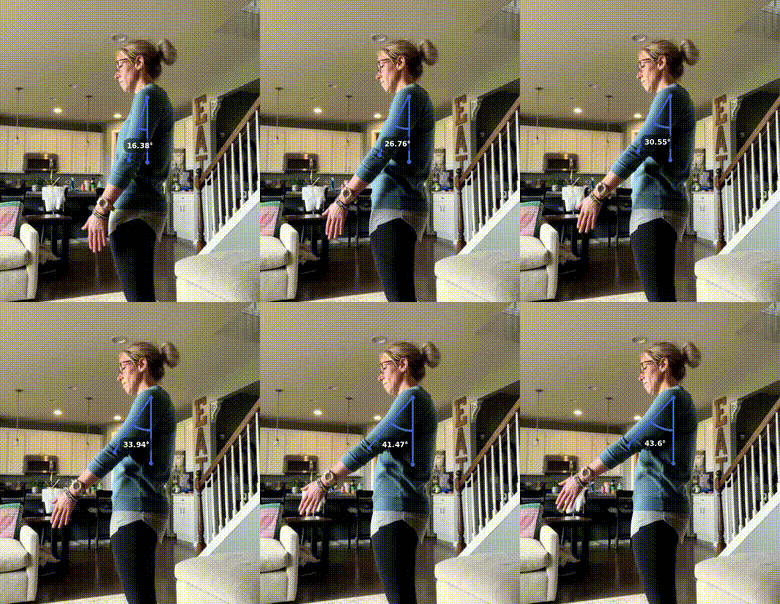
Automated Range of Motion (ROM) Measurement using Human Pose Estimation
We developed an automated Range of Motion (ROM) measurement web/mobile application for patient and healthcare providers with real-time monitoring and scalable deployment. The platform integrates over 200 active and passive ROM exercises, utilizing full-body pose estimation models to accurately analyze patient videos. Moreover, to boost model precision, we fine-tuned exercise-specific pose estimation models using custom in-house datasets. For scalability, we designed a distributed system with a master-slave architecture to efficiently manage high-volume API requests. We also leveraged Amazon EC2 and S3 to ensure a robust, cloud-based infrastructure, supporting seamless ROM assessments in both telehealth and clinical environments.
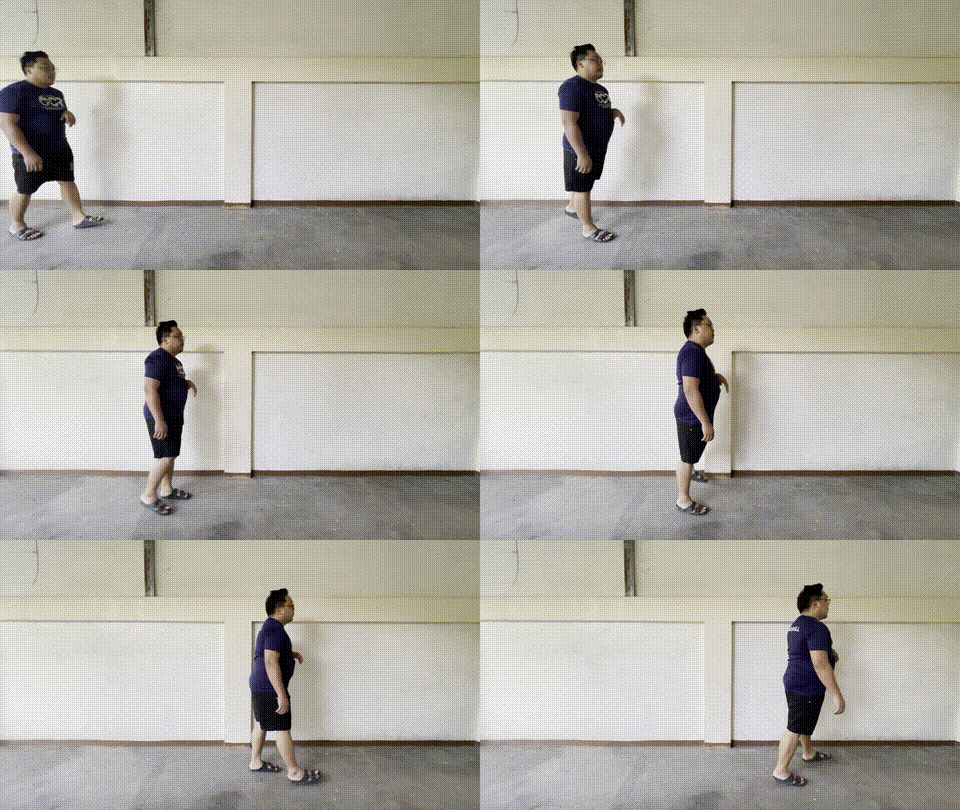
Abnormal Gait Analysis using Video-based Signal Processing
This project focuses on the development of an advanced gait event and abnormality detection system using pose estimation techniques. The system incorporates a signal-based approach to improve the accuracy of gait event detection, outperforming traditional angle-based methods, resulted in a patented solution. The project involved analyzing a diverse range of abnormal gait patterns, including Antalgic, Ataxic, Hemiplegic, Parkinsonian, and Trendelenburg gaits, using an in-house database of human participants. Collaborating closely with MyMedicalHUB's (MMH) clinical team of physicians and physical therapists, the project ensured clinical relevance and accuracy.
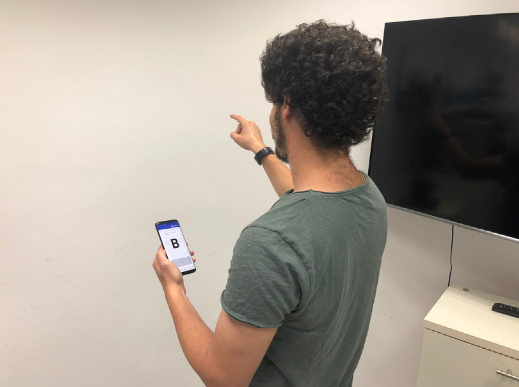
Deep Learning Based Air-Writing Recognition with the Choice of Proper Interpolation Technique
We developed a deep learning-based air-writing recognition system that addresses the critical challenge of variable signal length in time-series data through innovative interpolation techniques. Our method extensively investigated different interpolation techniques on seven publicly available air-writing datasets and developed a method to recognize air-written characters using a 2D-CNN model. In both user-dependent and user-independent principles, our method outperformed all the state-of-the-art methods by a clear margin for all datasets, achieving up to 100% accuracy on digit recognition and significant improvements across all character recognition tasks.